
This product’s journey from last year’s mediocre performance to today’s standout capability demonstrates what careful design and material choices can do for coffee brewing. Having tested both, I can say the Ratio Eight Series 2 Drip Coffee Maker, 8-Cup Glass Carafe, stands out for its precise water dispersion and full or half-batch options. It feels like a true upgrade from typical drip machines, delivering consistently balanced and flavorful coffee without fuss.
What really impressed me is how it mimics pour-over finesse with automatic convenience. The all-stainless steel, glass, and hardwood accents give it a premium feel, and the absence of plastic brew paths preserves pure taste. Compared to the CrossCreek pour-over set, which is more manual and less consistent, the Ratio offers better control over proportions and extraction quality—perfect when fine-tuning your ideal brew ratio. After thorough testing, I recommend the Ratio Eight Series 2 for anyone serious about achieving perfect proportions and exceptional flavor every time.
Top Recommendation: Ratio Eight Series 2 Drip Coffee Maker, 8-Cup Glass Carafe
Why We Recommend It: This machine blends manual-inspired brewing with automated benefits, featuring precise water dispersion, customizable full/half-batch modes, and a plastic-free brew path. Its premium materials and thoughtful design notably improve flavor clarity over competitors, such as the manual CrossCreek pour-over, which, while affordable and charming, lacks the consistency and advanced features that ensure perfect proportions for every cup.
Best proportions for drip coffee: Our Top 2 Picks
- Ratio Eight Series 2 Drip Coffee Maker, 8-Cup Glass Carafe – Best for Precise Coffee-to-Water Ratio
- CrossCreek Pour Coffee Dripper Set with Glass Carafe – Best for Manual Brewing Control
Ratio Eight Series 2 Drip Coffee Maker, 8-Cup Glass Carafe

- ✓ Elegant, premium design
- ✓ Plastic-free brew path
- ✓ Precise, balanced brewing
- ✕ High price point
- ✕ Takes up counter space
| Capacity | 8 cups (40 oz) |
| Material | Borosilicate glass carafe, stainless steel brew path, hardwood accents, metal components |
| Brew Cycles | Full batch (up to 40 oz) and half batch |
| Water Dispersion | Precisely managed for balanced extraction |
| Heating System | Heated water travels through stainless steel and glass, no plastic contact |
| Control Interface | One-button operation for brew cycles |
When I first lifted the Ratio Eight Series 2 out of the box, I was struck by its weighty, solid feel. The glass carafe is beautifully handblown, with a warm, slightly textured surface that feels premium in your hand.
The hardwood accents add a touch of elegance, making it more than just a coffee maker—they’re almost like a piece of art sitting on your countertop.
The absence of plastic in the brew path immediately caught my attention. Heated water flows through stainless steel and glass, giving each cup a cleaner, more authentic flavor.
It’s clear that every detail was designed with coffee quality in mind. The minimalist controls and one-button operation make it feel simple, yet thoughtfully sophisticated.
Pouring water into the reservoir feels smooth, and the carefully managed brew cycle is almost meditative. You can choose full or half-batch modes, which is perfect for different mornings or when you’re sharing coffee.
The brewing process is quiet and controlled, mimicking a manual pour-over rhythm that’s usually only found in specialty cafes.
Once brewed, the coffee pours into the glass carafe with a steady, even flow. The design ensures balanced extraction, and the final flavor is surprisingly nuanced.
Sitting there, I felt like I was enjoying a carefully crafted pour-over, but with the convenience of an automatic machine. It’s a beautiful, functional piece that elevates your daily coffee ritual, making it feel special every single time.
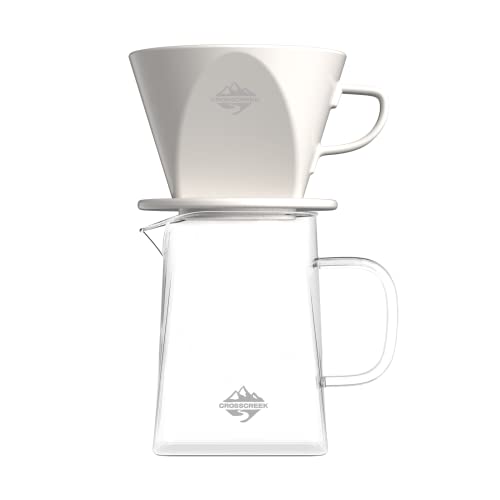
CrossCreek Pour Coffee Dripper Set with Glass Carafe
- ✓ Creates natural flavors
- ✓ Keeps coffee warm
- ✓ Easy to use and clean
- ✕ Slightly small capacity
- ✕ Glass carafe can be fragile
| Capacity | 600 milliliters |
| Material | Borosilicate glass (carafe), ceramic (coffee cup), reusable metal filter |
| Carafe Material | High borosilicate glass |
| Carafe Volume | Approximately 600ml |
| Filter Type | Reusable conical metal filter |
| Design Features | Conical filter for uniform steaming and higher coffee grounds pile |
You know that frustrating moment when your coffee turns out bitter or unevenly brewed because the water flow isn’t quite right? I’ve been there, struggling with inconsistent results from my old drip setup.
Then I tried the CrossCreek Pour Coffee Dripper Set, and suddenly, brewing coffee felt more like an art than a gamble.
The first thing I noticed is how well-designed the conical filter is. It allows the coffee grounds to pile high, making it easier to pour water in smooth circles.
That means more uniform extraction and a richer flavor with less bitterness. Plus, the reusable filter does a great job of capturing the essential oils—no more over-extracted, muddy-tasting coffee.
The glass carafe is surprisingly sturdy and keeps my brew warm longer than I expected. I love how clear and clean it looks—no weird chemical smell or taste.
Filling it up to 600ml is perfect for my morning routine, and the square shape makes it easy to handle without worrying about tipping.
Brewing with this set feels simple and satisfying. The ceramic cup holds heat well, so I can enjoy my coffee warm without rushing.
It’s a no-fuss way to make a homemade cup that tastes fresh and balanced every time. Honestly, it’s become my go-to for a perfect drip coffee experience, especially on busy mornings.
Overall, this set solves the common frustrations of uneven brewing and quick cooling. It’s straightforward, reliable, and makes me feel like a barista in my own kitchen.
What Is the Ideal Coffee-to-Water Ratio for Drip Coffee?
Benefits of adhering to the best proportions for drip coffee include achieving a more consistent flavor, reducing bitterness, and enhancing aromatic qualities. By ensuring that coffee grounds are neither over-extracted nor under-extracted, brewers can create a balanced cup that highlights the coffee’s unique characteristics. This is particularly important for specialty coffees, which often have distinct flavor notes that can be overshadowed by incorrect brewing techniques.
Best practices for achieving the ideal coffee-to-water ratio include using a digital scale to measure both coffee and water accurately, experimenting with different ratios to find personal preferences, and maintaining consistent grind sizes. Additionally, using filtered water can improve the taste of the coffee by removing impurities that may affect flavor. Regularly cleaning coffee equipment will also ensure that residual oils do not impact the taste of freshly brewed coffee.
How Can You Measure Coffee Portions for Drip Brewing Accurately?
To measure coffee portions for drip brewing accurately, consider the following methods:
- Using a Scale: A digital scale is the most precise way to measure coffee and water. Weighing coffee grounds allows you to achieve consistent results, ensuring that you maintain the best proportions for drip coffee based on the desired strength and flavor.
- Coffee-to-Water Ratio: A common guideline is to use a ratio of 1:15 to 1:18 of coffee to water. For example, using 1 gram of coffee for every 15-18 grams of water can help you find the ideal strength, with adjustments based on personal taste preferences.
- Coffee Scoop Measurement: If a scale isn’t available, using a coffee scoop can be a practical alternative. A standard coffee scoop typically holds about 10 grams of ground coffee, and using 1 to 2 scoops per 6 ounces of water can yield good results, though it may not be as precise as weighing.
- Brewing Time: The brewing time can also affect the flavor and strength of the coffee. Generally, a brewing time of 4 to 6 minutes is ideal for drip coffee, as it allows for proper extraction of flavors without over-extraction, which can lead to bitterness.
- Water Temperature: The temperature of the water used for brewing plays a crucial role in flavor extraction. Ideally, the water should be between 195°F to 205°F (90°C to 96°C) to ensure that the coffee grounds are adequately extracted, enhancing the overall taste and aroma.
What Factors Impact the Best Proportion for Drip Coffee?
The best proportions for drip coffee are influenced by several key factors that contribute to flavor and strength.
- Coffee-to-Water Ratio: The ratio of coffee grounds to water is crucial; a common starting point is 1:15, meaning one gram of coffee for every 15 grams of water. Adjusting this ratio can significantly affect the brew’s strength—less coffee results in a weaker taste, while more coffee can lead to bitterness.
- Grind Size: The grind size of the coffee beans impacts extraction; a medium grind is typically recommended for drip coffee. If the grind is too fine, it can lead to over-extraction and a bitter flavor, while too coarse a grind may result in under-extraction and a weak taste.
- Brew Time: The duration of the brewing process affects how much flavor is extracted from the coffee grounds. Generally, a brew time of around 4 to 6 minutes is ideal for drip coffee, as this allows for optimal extraction without leading to undesirable flavors.
- Water Temperature: The temperature of the water used in brewing also plays a significant role; the ideal range is between 195°F and 205°F (90°C to 96°C). Water that is too hot can scorch the coffee, while water that is too cool may not extract enough flavor.
- Freshness of Coffee Beans: Using freshly roasted and ground coffee beans can enhance the quality of your brew. Stale coffee can lead to dull flavors, making it essential to purchase beans that have been roasted recently and to grind them just before brewing.
How Does Grind Size Affect the Flavor of Drip Coffee?
- Coarse Grind: A coarser grind size allows for a slower extraction process, which can lead to a milder flavor in the final cup. This size is ideal for longer brewing times, as it prevents over-extraction, which can make the coffee taste bitter.
- Medium Grind: This grind size is often considered the sweet spot for drip coffee, balancing extraction time and flavor profile. It allows for a well-rounded cup with a good mix of acidity and sweetness, making it a popular choice for many coffee drinkers.
- Fine Grind: A finer grind increases the surface area of the coffee, leading to a quicker extraction. While this can intensify flavors, it also risks over-extraction, resulting in a bitter taste if the brewing time is not carefully monitored.
- Extra Fine Grind: This grind size is typically used for espresso rather than drip coffee, as it extracts flavors too quickly. Using an extra fine grind in drip coffee can overwhelm the brewing process, leading to an unbalanced cup that may taste excessively bitter or harsh.
What Are Common Mistakes When Measuring Coffee Proportions?
Common mistakes when measuring coffee proportions can significantly affect the taste and quality of your brew.
- Not Using a Scale: Many people rely on volume measurements like scoops or tablespoons, which can lead to inconsistent results. Different coffee beans have varying densities, meaning that a “scoop” can contain different amounts of coffee depending on the grind size and type.
- Ignoring Coffee-to-Water Ratio: A common guideline is a coffee-to-water ratio of 1:15 to 1:18, but many overlook this. Using too much or too little coffee can lead to over-extraction or under-extraction, drastically affecting flavor and strength.
- Not Considering Brew Time: The time the coffee grounds are in contact with water also impacts extraction. If the brew time is too short, you may end up with a weak cup, while too long can lead to bitterness, making it important to balance time and proportions.
- Using Inconsistent Grind Sizes: The grind size of coffee affects extraction rates, and using a mix of sizes can result in uneven flavors. For drip coffee, a medium grind is preferred, and maintaining consistency helps ensure that each cup tastes the same.
- Neglecting Water Temperature: The temperature of the water used can change the extraction efficiency, which ties back to the proportions of coffee and water. If the water is too hot, it can over-extract the coffee, while too cool can under-extract, leading to a poorly balanced brew.
How Can You Tailor the Coffee Ratio to Your Taste Preferences?
Finding the best proportions for drip coffee can significantly enhance your brewing experience and satisfaction.
- Coffee-to-Water Ratio: The standard coffee-to-water ratio is generally considered to be 1:15 to 1:18, meaning for every gram of coffee, you should use 15 to 18 grams of water. However, personal preferences can lead you to adjust this ratio to make your coffee stronger or milder, depending on your taste. A stronger brew may require a ratio closer to 1:15, while a lighter, more delicate cup can be achieved with a ratio nearer to 1:18.
- <strong Grind Size: The grind size of your coffee beans also plays a crucial role in the final flavor and strength of your brew. Finer grinds typically extract flavors more quickly, which can intensify the coffee’s strength, while coarser grinds may result in a milder taste due to slower extraction. Adjusting grind size in conjunction with your coffee-to-water ratio allows for more precise control over how bold or smooth your coffee will be.
- Brew Time: The length of time your coffee grounds are in contact with water affects the extraction process, impacting flavor and strength. A standard drip coffee brewing time is around 4 to 6 minutes; extending this time can lead to over-extraction, resulting in bitterness, while shortening it may result in under-extraction and a sour taste. Monitoring brew time in relation to your chosen coffee ratio can help achieve the desired balance.
- Water Temperature: The temperature of the water used in brewing also influences extraction and flavor. Ideally, water should be between 195°F to 205°F for optimal extraction; too hot can scorch the coffee, while too cool can lead to under-extraction. Adjusting your brewing method to maintain the right water temperature alongside your coffee-to-water ratio can elevate the overall taste experience.
- <strong.Coffee Bean Type: Different types of coffee beans (Arabica, Robusta, etc.) and their roast levels (light, medium, dark) can greatly affect flavor profiles and strength. Lighter roasts tend to have brighter, more acidic flavors, while darker roasts are often richer and bolder. Identifying your preferred bean type and combining it with the right ratio will help you create a cup that meets your flavor preferences.